Created on 2026-11-28
What Does an Engineering Manager Actually Do? 10 Anti-Patterns Ranked From Annoying to Toxic
Ask ten people in tech what an Engineering Manager is responsible for and you will get ten different answers.
That ambiguity is dangerous. When a role has no clear boundaries, people fill the vacuum with whatever gives them comfort, status, or power. Some turn into full-time Jira operators. Some collect invitations to exclusive meetings so they feel part of a "special" group. Others take the title because they want the ability to control other people.
None of those are engineering management. They are management theater - and more often than not, the company's engineering culture quietly selects for them.
Here are ten broken manager archetypes ranked from #10 (misguided, usually fixable) down to #1 (actively destroys teams), followed by why company culture decides which ones thrive and what the role actually owns.
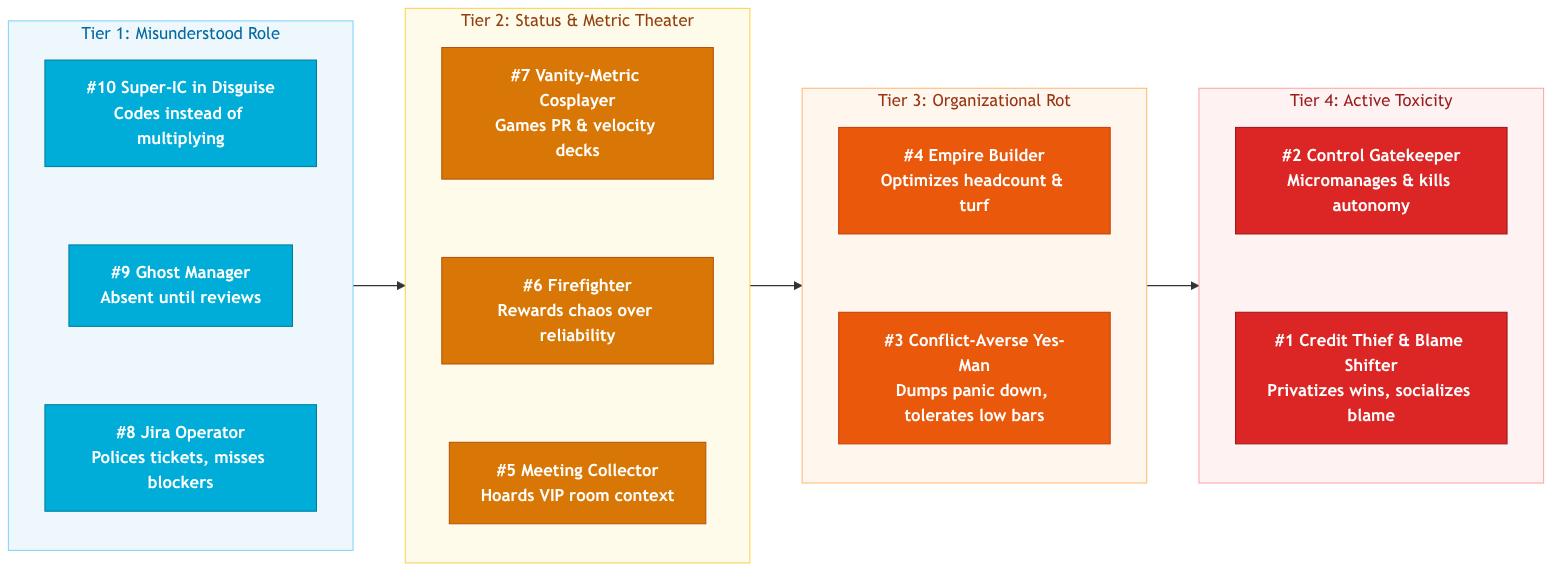
The 10 Engineering Manager Anti-Patterns (Worst Last)
10. The Super-IC in Disguise
Usually promoted because they were the strongest engineer on the team, this manager never actually stepped away from the keyboard. They still grab the most interesting technical work, jump into every production incident as the hero, and make architecture decisions solo.
On the surface, teams prefer them over non-technical bosses because they understand the stack. Underneath, they starve senior engineers of ownership, neglect career growth and 1:1s, and burn out trying to do two full-time jobs poorly. (This is also where unmanaged vibe coding creeps back in - managers chasing the rush of shipping code while leaving real management work undone.) It lands at #10 because the intent is rarely malicious, and the fix is straightforward: real leadership coaching, or a Staff/Principal IC track so great builders do not feel forced into management.
9. The Ghost Manager
The exact opposite of micromanagement, and still a failure. The Ghost Manager hides behind "I hire adults and give them full autonomy" - which really means they disappear between quarterly performance reviews.
Senior engineers can survive this for a few months. Juniors flounder without feedback, cross-team blockers sit unresolved for weeks, and when budget cuts or reorgs hit, the team has zero air cover because their manager never showed up to advocate for them.
8. The Jira Operator
This manager treats project tracking software as the entire job. Their week revolves around grooming boards, chasing status updates before standup, policing story-point estimates, and asking "can you move that ticket to In Review?" three times a day.
They operate as an expensive human webhook between product and developers. While they polish sprint burndown charts, the actual bottlenecks - flaky CI, vague specs, cross-team dependencies, and rotting infrastructure - go untouched. The board looks spotless while real delivery slows to a crawl.
7. The Vanity-Metric Cosplayer
Worse than Jira gardening because it actively corrupts engineering behavior. Unable or unwilling to evaluate real system health, this manager governs through metrics that look clean in executive slide decks: PR counts, lines of code, ticket velocity, or raw deploy frequency stripped of reliability context.
Engineers quickly adapt to whatever gets graphed for the VP. Large changes get chopped into pointless micro-PRs, risky shortcuts skip proper review to hit sprint targets, and real health signals - incident recovery time, on-call fatigue, customer pain - stay buried until production breaks loudly.
6. The Firefighter (The Chaos Addict)
This manager only feels alive in war rooms, emergency Slack channels, and late-night rollbacks. They love visible heroics and quietly starve boring preventive work: automated testing, observability, proper runbooks, and paying down tech debt.
Calm, predictable platforms do not make them look busy in front of leadership. The result is a self-reinforcing loop: underinvest in reliability, wait for the inevitable outage, rally the team for a weekend rescue, collect praise for "saving the day," and watch your best engineers burn out and quit.
5. The Inner-Circle Meeting Collector
Some people do not want to manage engineering outcomes - they want to be in the room.
Their calendar is packed wall-to-wall with alignment syncs, steering committees, and private #leadership-only channels. Belonging to a "special" group feels like proof of status. The real damage is what happens to information: context flows into those closed rooms and rarely comes back out. Engineers get blindsided by sudden roadmap pivots while the manager hoards context because being the only person who "knows what executives think" is their main source of relevance.
4. The Empire Builder
This manager measures success strictly by org-chart territory: headcount, number of services owned, budget size, and how many cross-team committees require their sign-off.
Simplifying an architecture, deleting a redundant microservice, or handing ownership to a better-suited team threatens their footprint - so they fight simplification at every turn. Over a year or two, an Empire Builder turns a lean engineering org into duplicated platforms, artificial boundaries, and endless turf wars where shipping a simple feature requires negotiating across four teams.
3. The Conflict-Averse Relay (The Upward Yes-Man)
A huge part of management is absorbing organizational noise and pushing back on bad trade-offs. The Conflict-Averse Relay does the exact opposite: they say "yes" to every unrealistic executive or sales deadline, then forward the panic straight down as "leadership says this has to ship Friday."
The same avoidance happens downward. They dodge uncomfortable performance conversations, tolerate broken habits to keep the peace, and hope problems fix themselves. Top performers end up carrying the extra load, realize standards do not matter, and quietly head for the exit.
2. The Control Gatekeeper
This archetype wanted the manager title for one reason: the authority to control other people.
They insist on approving every PR, dictating how engineers implement solutions instead of aligning on what outcome matters, gating routine deploys behind personal sign-off, and turning 1:1s into status interrogations. Autonomy dies fast. Capable seniors either spend half their energy fighting for basic trust or switch into passive order-taker mode because every independent decision gets overridden anyway. The entire team shrinks to the size of one person's ego and bottleneck.
1. The Credit Thief and Blame Shifter
The single most destructive archetype in engineering management.
They manage strictly upward with one rule: privatize credit, socialize blame. When a risky migration lands cleanly, their executive update reads "I delivered this ahead of schedule." When an incident hits or a timeline slips, it immediately becomes "the engineers underestimated the work" - or worse, naming an individual in front of senior leadership.
Psychological safety evaporates overnight. Nobody takes smart technical risks, nobody surfaces bad news early while it is still cheap to fix, and engineers start spending more energy writing defensive paper trails than building software. A Jira Operator wastes your time; a Credit Thief and Blame Shifter hollows out an entire engineering organization.
How Company Engineering Culture Decides Which Archetype Wins
It is easy to treat all ten patterns as individual character flaws. Sometimes it really is the wrong person in the wrong seat. Just as often, the company's engineering culture manufactures and rewards the exact behavior you hate.
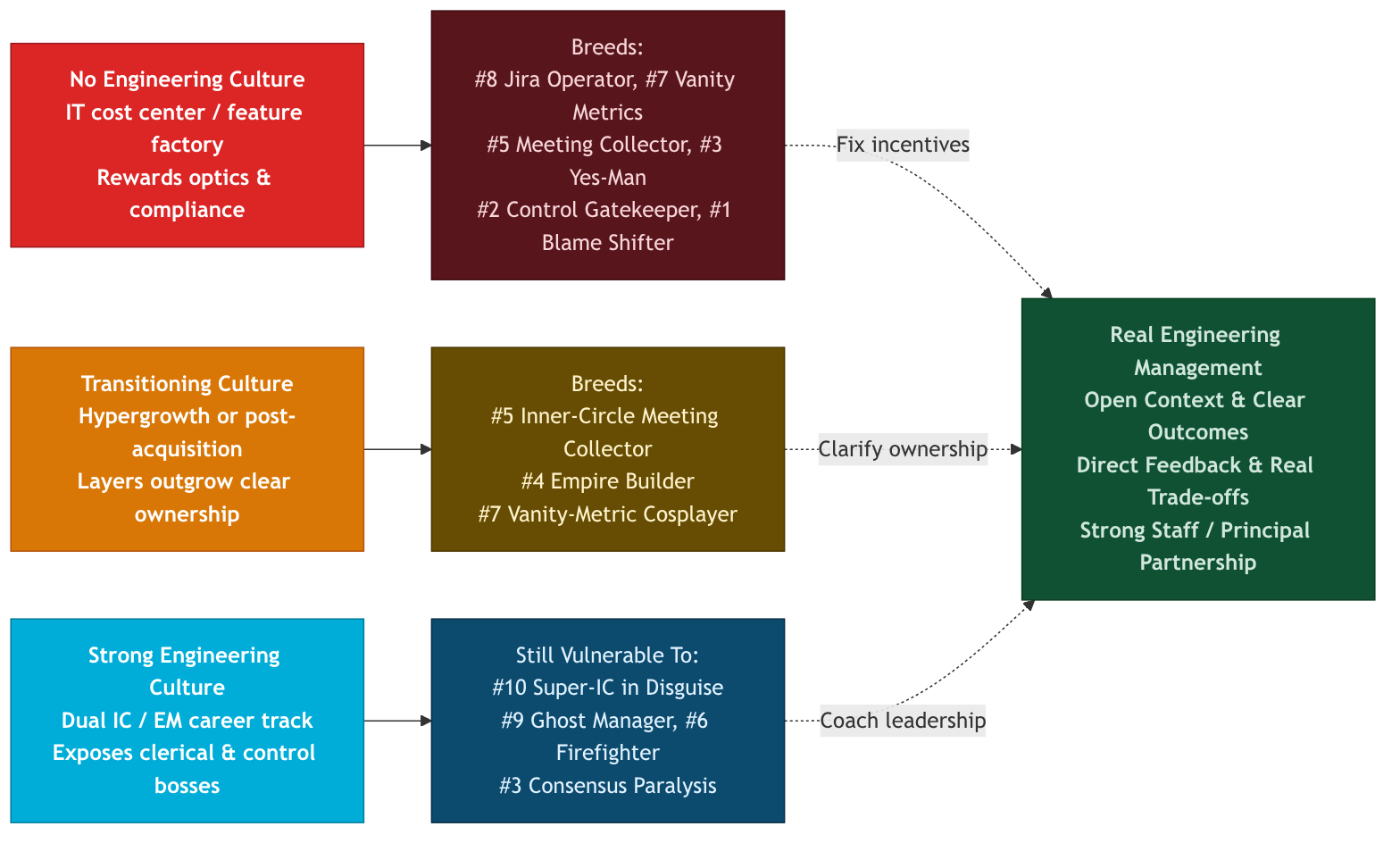
Companies Without Engineering Culture
When a company treats engineering as an IT cost center or a feature factory, non-technical executives cannot evaluate architectural quality, reliability, or hiring bars. They reward green status reports, obedience, and optics.
That environment is a breeding ground for #8 (Jira Operator), #7 (Vanity-Metric Cosplayer), #5 (Inner-Circle Meeting Collector), #3 (Yes-Man), #2 (Control Gatekeeper), and #1 (Credit Thief and Blame Shifter). Pushing back on an impossible deadline looks like "bad attitude." Deleting unnecessary meetings looks like "lack of alignment." Even a strong engineering manager struggles here because doing the real job conflicts with what leadership visibly rewards.
Companies With Strong Engineering Culture
In companies where engineering is a core value driver - with a genuine IC career track (Staff and Principal engineers who do not need a manager title to earn pay or influence) - Jira operators and pure control freaks get exposed fast. Strong engineers simply will not stay under a human ticket mover or micromanager.
Strong engineering cultures do not eliminate bad management; they shift which patterns survive:
- #10 (Super-IC in Disguise) shows up constantly because deep technical skill got them promoted, and letting go of the keyboard is genuinely hard.
- #9 (Ghost Manager) hides behind real autonomy slogans until juniors stall or org politics hit.
- #6 (Firefighter) thrives in move-fast cultures that celebrate heroic saves over boring operational discipline.
- #3 (Conflict-Averse Relay) lingers when "high trust and consensus" turns into nobody making an unpopular call.
Companies in Transition (Hypergrowth or Post-Acquisition)
The subtlest trap happens when a builder-led company scales rapidly or gets acquired. Layers of middle management appear faster than clear ownership boundaries.
Almost overnight, #5 (Inner-Circle Meeting Collector), #4 (Empire Builder), and #7 (Vanity-Metric Cosplayer) start multiplying. Private alignment groups form, slide decks replace technical reviews, and long-time engineers wonder when the company stopped rewarding people who ship.
What Engineering Management Actually Owns
Strip away all ten anti-patterns and the role boils down to four clear responsibilities:
| Responsibility | Management theater | Real engineering management |
|---|---|---|
| Clarity and context | Hoards info from private meetings (#5) or disappears (#9) | Translates business goals into clear Why and priorities; shares context openly (see the 5W method) |
| Ownership and execution | Moves Jira cards (#8), games dashboards (#7), or micromanages (#2) | Sets outcomes, constraints, and quality bar; trusts engineers with the How and clears real blockers |
| People and standards | Dodges tough talks (#3) or shifts blame upward (#1) | Hires well, coaches growth, gives direct feedback early, owns failures publicly, credits the team |
| Trade-offs and judgment | Competes as a Super-IC (#10), chases fires (#6), or builds empires (#4) | Cuts scope, defends reliability and tech debt time, simplifies boundaries, partners with Staff/Principal ICs |
A developer's output is what they build. A manager's output is the sustainable impact of the team - what they ship, how reliably it runs, and whether strong engineers still want to work there a year from now.
Five Questions to Spot the Anti-Patterns Early
Whether you are auditing your own management habits or interviewing a future manager, five questions expose almost every archetype on this list:
- What decisions did your team make last month without asking your permission? If almost none, watch out for #2 (Control Gatekeeper).
- Tell me about a project that failed under your leadership - what was your part in it? If every sentence blames engineers, product, or "unexpected complexity," you are looking at #1 (Credit Thief and Blame Shifter).
- When did you last push back on an executive deadline or cut scope - and what happened? No concrete example points straight to #3 (Yes-Man) or a company without engineering culture.
- How do engineers learn why a company priority changed? If context stays locked in leadership calls, expect #5 (Inner-Circle Meeting Collector).
- What broke when you took two weeks off? If nothing moved, you have #10 (Super-IC) or #2 (Control Gatekeeper); if nobody noticed you were gone for a quarter, you might have #9 (Ghost Manager).
Final Thought
Management is not clerical ticket work, a VIP pass to leadership rooms, or a permit to boss developers around. Done well, it is a hard, unglamorous craft that multiplies everyone around it.
Before judging a manager - or stepping into the role yourself - look at two things: what the person optimizes for every day, and what the company's engineering culture quietly rewards. Fix the incentives and the ownership boundaries, and most of the theater disappears.