Created on 2026-11-26
Kubernetes Hardening L0: Physical, Firmware, and Boot Trust on Bare Metal vs Cloud
TL;DR: Pod Security Standards, eBPF policies, and RBAC mean nothing if an attacker can boot an unsigned kernel, pull a drive from a decommissioned chassis to read raw etcd blocks, or pivot from a compromised pod into an unsegmented iDRAC interface. On managed clouds, hypervisor and silicon roots of trust are largely built for you - though you still have to turn on the right flags. On bare metal, Layer 0 is entirely your problem: UEFI Secure Boot with Unified Kernel Images (UKIs), TPM 2.0 PCR-sealed LUKS2 partitions, continuous remote attestation with Keylime (CNCF Sandbox), hardware-backed node identity via SPIFFE/SPIRE (CNCF Graduated), and physically air-gapped out-of-band (OOB) management networks.
The Premise: Software Controls Depend on Hardware Integrity
Every control in the upper layers of Kubernetes assumes the Linux kernel on the worker or control-plane node is telling the truth. If an adversary modifies the initramfs, injects a malicious kernel module before kubelet starts, or mounts a virtual ISO through a Baseboard Management Controller (BMC), they sit underneath seccomp, underneath namespaces, and underneath Cilium's eBPF programs.
At Layer 0, hardening answers four concrete questions:
- Boot integrity: Did this machine boot an authentic, vendor- or platform-signed firmware, bootloader, kernel, and initramfs?
- Data-at-rest protection: If someone pulls the NVMe drive out of the server sled, are the
STATE(kubelet client keys,etcddata) andEPHEMERAL(container rootfs, mounted secrets) partitions cryptographically unreadable? - Node attestation: Can the control plane cryptographically verify that a node requesting workload identity is a genuine physical machine running an untampered boot chain - and not an attacker spinning up a rogue VM on the management VLAN?
- Out-of-band isolation: Is the BMC (iDRAC, iLO, Redfish, IPMI) completely unreachable from the workload and host networks?
Managed (EKS / GKE / AKS) vs. Self-Hosted Bare Metal
Layer 0 is where the operational gap between managed Kubernetes and self-hosted bare metal is widest. Cloud providers invest heavily in custom silicon (AWS Nitro, Google Titan) and virtualized TPMs (vTPM), exposing hardware trust as a few boolean parameters in your Terraform node group definitions. On bare metal, you are the cloud provider.
| Capability | AWS EKS | Google GKE | Azure AKS | Self-Hosted Bare Metal |
|---|---|---|---|---|
| Hardware Root of Trust | AWS Nitro System (hardware-verified firmware, DMA protection) | Titan security chip + Shielded VM infrastructure | Azure Boost + Host hardware root of trust | Physical TPM 2.0 chip (discrete or firmware fTPM) + vendor silicon root (Intel Boot Guard / AMD Platform Secure Boot) |
| UEFI Secure Boot | AMI-level setting (boot_mode = "uefi" + custom UEFI Secure Boot key store on custom AMIs; stock AL2023 uefi-preferred does not enforce Secure Boot) |
GKE Shielded Nodes (enable_secure_boot = true) |
Trusted Launch (secure_boot_enabled = true) |
You own it: Enroll custom PK/KEK/db keys or use signed Unified Kernel Images (Talos SecureBoot / Flatcar) |
| Measured Boot & vTPM | Nitro TPM (tpm_support = "v2.0" registered on the AMI) / Nitro Enclaves |
Shielded Nodes vTPM (enable_integrity_monitoring = true) |
Trusted Launch vTPM (vtpm_enabled = true) |
You own it: TPM 2.0 PCR banks (SHA-256) + remote attestation via Keylime |
| Node Disk Encryption | EBS encryption with KMS CMK (handled below the guest OS) | Persistent Disk boot volume with Cloud KMS CMEK (local NVMe SSDs use ephemeral Google-managed hardware keys) | Server-side SSE-CMK (DiskEncryptionSet) for managed OS disks, or encryption at host (host_encryption_enabled = true) for ephemeral OS disks (distinct from legacy guest-side ADE) |
You own it: In-OS LUKS2 bound to TPM 2.0 PCRs + network KMS fallback (Tang/Clevis or Sidero Omni KMS) |
| BMC / Out-of-Band Access | Abstracted by AWS (EC2 Serial Console IAM-gated) | Abstracted by GCP | Abstracted by Azure | You own it: Dedicated OOB switch/VLAN, Redfish TLS 1.2+, IPMI Cipher 0 disabled, Bastion MFA |
| Declarative Provisioning | Managed Node Groups / Karpenter (Kubernetes SIG Autoscaling subproject) | Node Pools / Node Auto-Provisioning | Virtual Machine Scale Sets (VMSS) / Karpenter (NAP) | Metal3 (CNCF Incubating), Tinkerbell (CNCF Sandbox), or Sidero Omni |
Enabling Layer 0 Controls on Managed Clouds
Do not assume cloud defaults enable every boot-integrity check. While GKE enables Shielded Nodes by default on modern clusters, explicit verification in your Infrastructure-as-Code prevents regressions.
On AWS EKS, note two common traps before writing your Launch Template:
- UEFI Secure Boot and Nitro TPM live on the AMI, not the Launch Template. Registering a custom AMI with
--boot-mode uefi,--tpm-support v2.0, and--uefi-data(customPK/KEK/dbvariables) enforces Secure Boot and vTPM; stock AL2023uefi-preferredAMIs do not enforce Secure Boot on their own. - Custom
image_idrequires explicituser_data. When you specifyimage_idin an EKS Managed Node Group Launch Template, AWS stops injecting its automatic bootstrap script. For Bottlerocket AMIs, you must pass TOMLuser_datawith[settings.kubernetes]or the node boots and never joins the cluster.
# AWS EKS: Hardened EC2 Launch Template referencing a UEFI/Nitro-TPM Bottlerocket AMI,
# enforcing IMDSv2 hop-limit 1, CMEK EBS volumes, and mandatory Bottlerocket join TOML.
resource "aws_launch_template" "eks_hardened_nodes" {
  name_prefix = "eks-prod-hardened-"
  # Custom or verified Bottlerocket AMI registered with boot_mode = "uefi" and tpm_support = "v2.0"
  image_id = var.hardened_bottlerocket_ami_id

  # Mandatory when image_id is specified on an EKS Managed Node Group Launch Template
  user_data = base64encode(<<-EOT
    [settings.kubernetes]
    cluster-name = "${var.cluster_name}"
    api-server = "${var.cluster_endpoint}"
    cluster-certificate = "${var.cluster_ca_data}"
  EOT
  )

  # Require IMDSv2 and restrict hop limit to 1 so containers cannot reach EC2 metadata
  metadata_options {
    http_endpoint               = "enabled"
    http_tokens                 = "required"
    http_put_response_hop_limit = 1
    instance_metadata_tags      = "disabled"
  }

  # Encrypt both OS boot volume and containerd data volume with a Customer-Managed KMS Key
  block_device_mappings {
    device_name = "/dev/xvda"
    ebs {
      volume_size           = 4
      volume_type           = "gp3"
      encrypted             = true
      kms_key_id            = aws_kms_key.eks_node_cmek.arn
      delete_on_termination = true
    }
  }

  block_device_mappings {
    device_name = "/dev/xvdb"
    ebs {
      volume_size           = 100
      volume_type           = "gp3"
      iops                  = 3000
      throughput            = 250
      encrypted             = true
      kms_key_id            = aws_kms_key.eks_node_cmek.arn
      delete_on_termination = true
    }
  }
}

# GKE: Enforce Shielded Nodes with Secure Boot, vTPM Integrity Monitoring, and CMEK Boot PD
resource "google_container_node_pool" "hardened_pool" {
  name       = "hardened-workers"
  cluster    = google_container_cluster.primary.id
  location   = var.region
  node_count = 3

  node_config {
    image_type = "COS_CONTAINERD"
    disk_type  = "pd-ssd"
    # Encrypts the Persistent Disk boot volume with CMEK (local NVMe SSDs use ephemeral Google-managed keys)
    boot_disk_kms_key = google_kms_crypto_key.node_disk_cmek.id

    shielded_instance_config {
      enable_secure_boot          = true
      enable_integrity_monitoring = true
    }

    metadata = {
      disable-legacy-endpoints = "true"
    }
  }
}

# AKS: Enforce Trusted Launch (UEFI Secure Boot + vTPM) and Host Encryption for Ephemeral OS Disks
resource "azurerm_kubernetes_cluster_node_pool" "hardened_aks" {
  name                  = "hardened"
  kubernetes_cluster_id = azurerm_kubernetes_cluster.primary.id
  vm_size               = "Standard_D4ds_v5"
  os_sku                = "AzureLinux"

  # Explicitly enforce UEFI Secure Boot and vTPM Attestation via Trusted Launch
  secure_boot_enabled = true
  vtpm_enabled        = true
  ultra_ssd_enabled   = false
  os_disk_type        = "Ephemeral"
  # Required to encrypt Ephemeral OS disks and temp disks at the host layer (requires EncryptionAtHost feature)
  host_encryption_enabled = true
}
When enable_integrity_monitoring is active on GKE (or Trusted Launch with Microsoft Defender for Cloud on AKS), the hypervisor compares the latest boot measurement stored in the vTPM PCRs against the known-good baseline and emits a Cloud Logging alert if early-boot tampering occurs. If you use os_disk_type = "Managed" on AKS instead of Ephemeral, bind a disk_encryption_set_id (SSE-CMK backed by Azure Key Vault) on the cluster rather than legacy guest-side Azure Disk Encryption (ADE).
Bare Metal Deep Dive: Building the Hardware Root of Trust
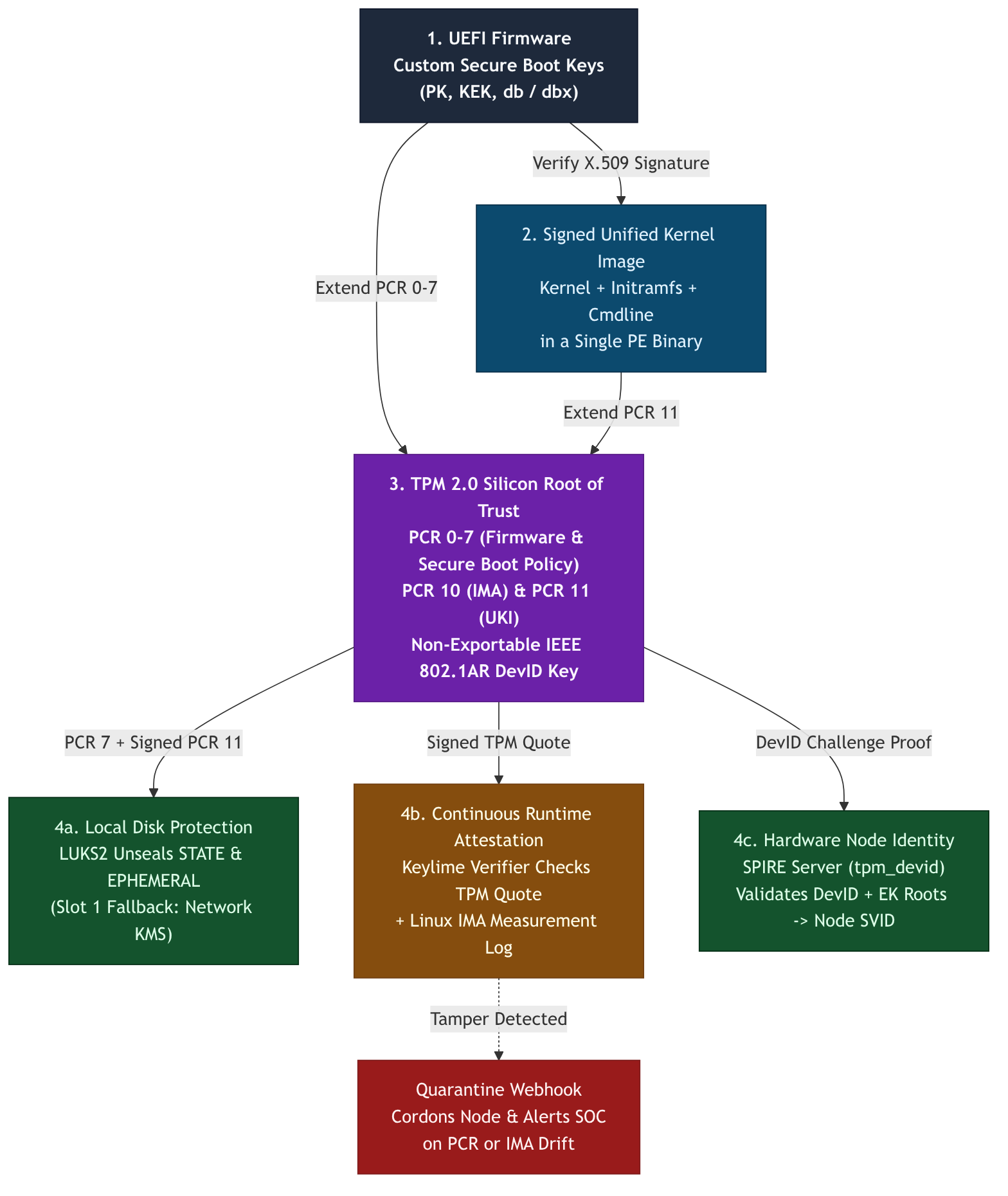
On bare metal, there is no hypervisor underneath your node OS to encrypt block devices transparently or validate vTPM state. You must build a cryptographic chain of trust from the motherboard's SPI flash all the way to the unsealed disks and hardware-attested node identity.
1. UEFI Secure Boot and Unified Kernel Images (UKIs)
Traditional Linux Secure Boot chains often have a fatal gap: UEFI verifies the bootloader (shim + GRUB), and GRUB verifies the kernel image (vmlinuz), but the initramfs and kernel command-line parameters (cmdline) sit unverified in /boot. An attacker with brief physical access or an offline disk mount can unpack the initramfs, drop a reverse shell script into /init, and add init=/bin/sh to the kernel command line without breaking the kernel signature check.
The modern fix is the Unified Kernel Image (UKI). A UKI packages the UEFI stub (systemd-stub), the Linux kernel, the initramfs, and the hardened kernel command line into a single PE/COFF binary signed as a single cryptographic unit.
On bare metal, Talos Linux uses this exact architecture:
- The entire OS is delivered as a signed UKI (
vmlinuz+ SquashFS rootfs insideinitramfs+ fixed kernel parameters). - Custom Platform Keys (
PK), Key Exchange Keys (KEK), and Signature Database (db) keys can be enrolled directly into the server's UEFI NVRAM during initial provisioning so the server only boots UKIs signed by your organization's offline signing key - rejecting even standard Microsoft-signed third-party shims.
2. TPM 2.0 Measured Boot and LUKS2 Disk Encryption
Even with Secure Boot enforced, a decommissioned drive pulled from a data center rack contains STATE (node identity, etcd database on control-plane nodes) and EPHEMERAL (/var/lib/kubelet, unpacked container layers, volume mounts). Full-disk encryption is mandatory, but bare-metal servers in a lights-out data center cannot wait for an operator to type a LUKS passphrase on an iKVM console after every kernel upgrade.
This is solved by binding LUKS2 key slots to TPM 2.0 Platform Configuration Registers (PCRs):
- PCR 0 - 5: Measure UEFI firmware code, configuration, and option ROMs.
- PCR 7: Measures the UEFI Secure Boot state and the exact X.509 certificates (
PK,KEK,db,dbx) used to verify the boot binary. - PCR 11: Measures the Unified Kernel Image components (
systemd-stubmeasures each PE section of the UKI into PCR 11).
Instead of sealing the LUKS2 key against brittle PCR hashes that break every time you upgrade the kernel (such as raw PCR 4/8/9 hashes), modern immutable OSs like Talos seal the disk key against PCR 7 (Secure Boot policy) and a signed PCR 11 policy (requiring that the booted UKI is signed by the trusted Talos signing key).
Here is a production Talos machine configuration snippet enforcing Secure Boot, TPM 2.0 PCR-locked LUKS2 encryption for both STATE and EPHEMERAL partitions, and a network KMS fallback:
# talos-machine-patch-l0.yaml
machine:
  install:
    # PRODUCTION BEST PRACTICE: Never hardcode /dev/nvme0n1 on multi-drive servers
    # (Linux NVMe enumeration order is asynchronous and can swap across cold boots).
    # Always select the OS boot drive deterministically by WWN, busPath, or model/size:
    diskSelector:
      size: "<= 512GB"
      model: "SAMSUNG MZVL2512HCJQ*"
      busPath: "/pci0000:00/0000:00:01.0/0000:01:00.0/nvme/nvme*"
    # Use the official SecureBoot UKI installer image (Talos v1.13.0)
    image: factory.talos.dev/installer-secureboot/376567988ad370138ad8b2698212367b8edcb69b5fd68c80be1f2ec7d603b4ba:v1.13.0
    wipe: false
  systemDiskEncryption:
    state:
      provider: luks2
      options:
        - no_read_workqueue
        - no_write_workqueue
      keys:
        - slot: 0
          tpm:
            # Only unseal if UEFI Secure Boot is active and PCR 7 + signed PCR 11 policy match
            checkSecurebootStatusOnEnroll: true
        - slot: 1
          # Fallback slot sealed via out-of-band network KMS (survives motherboard RMA / BIOS recovery)
          kms:
            endpoint: https://kms.infra.bard.sh:443
    ephemeral:
      provider: luks2
      options:
        - no_read_workqueue
        - no_write_workqueue
      keys:
        - slot: 0
          tpm:
            checkSecurebootStatusOnEnroll: true
        - slot: 1
          kms:
            endpoint: https://kms.infra.bard.sh:443
Verify the Secure Boot and UKI state via the mutually authenticated Talos API (talosctl):
# Confirm Secure Boot summary in tabular output
talosctl -n 10.30.0.11 get securitystate
# NODE         NAMESPACE   TYPE            ID              VERSION   SECUREBOOT
# 10.30.0.11   runtime     SecurityState   securitystate   1         true

# Inspect full SecurityState fields (secureBoot, bootedWithUKI, signing key fingerprint)
talosctl -n 10.30.0.11 get securitystate -o yaml
If you run Flatcar Container Linux (CNCF Incubating) instead of Talos, you achieve the same layout via Butane/Ignition config using systemd-cryptenroll --tpm2-device=auto --tpm2-pcrs=7 paired with a Clevis/Tang network pin for high-availability fallback.
Stopping Rogue Nodes: Remote Attestation with Keylime and SPIRE
Secure Boot and TPM disk sealing protect a single machine from offline tampering. They do not stop an attacker who has gained access to your management VLAN from booting their own laptop or rogue VM and attempting to join the cluster or request workload identities.
To close that gap, you need remote attestation and hardware-bound node identity. These are two complementary mechanisms: Keylime continuously monitors boot measurements and runtime IMA integrity and triggers quarantine webhooks on drift, while SPIRE independently attests hardware TPM identity before issuing Node SVIDs.
Continuous Attestation with Keylime
Keylime provides scalable, continuous TPM 2.0 remote attestation and runtime Integrity Measurement Architecture (IMA) verification. Note the host OS requirement: the Rust keylime_agent runs directly on IMA-enabled Linux distributions such as Flatcar Container Linux or RHEL / Fedora CoreOS. Because Talos Linux has no mutable package manager or host shell, running Keylime on Talos requires packaging keylime_agent as a custom Talos system extension (via Image Factory) - otherwise rely on Talos's built-in TPM PCR 7 + signed PCR 11 sealing paired with SPIRE tpm_devid.
- Each bare-metal node has a unique Endorsement Key (
EK) burned into its TPM 2.0 chip at the factory, and generates a restricted Attestation Key (AK) inside the TPM. - The Keylime Registrar and Verifier periodically challenge the Keylime Agent on each node with a cryptographic nonce.
- The TPM signs a TPM Quote over its current PCR values (
0-11) and the Linux kernel's IMA measurement log (which hashes every binary and shared library executed at runtime into PCR 10). - If a node's PCR values deviate from the golden reference state - or an unauthorized binary executes on the host - the Keylime Verifier immediately fires a revocation webhook to a routable management-enclave controller that cordons the node and alerts the SOC.
# /etc/keylime/verifier.conf (running on the management enclave)
[verifier]
ip = 10.30.0.5
port = 8881
registrar_ip = 10.30.0.6
registrar_port = 8891
tls_dir = /var/lib/keylime/cv_ca
enable_agent_mtls = True
# Select your measured-boot policy module; supply golden PCRs via keylime_tenant --mb-refstate
measured_boot_policy_name = example

[revocations]
enabled_revocation_notifications = ['webhook']
# Must be a routable management-enclave HTTPS endpoint (never an in-cluster .svc DNS name)
webhook_url = https://quarantine.infra.bard.sh:8443/v1/revoke-node
Keylime IMA runtime policies and measured-boot reference states are attached per node at enrollment time using keylime_tenant, not inside verifier.conf:
# Enroll a Flatcar or RHEL node with an IMA runtime policy and measured-boot reference state
keylime_tenant -c add \
  -t 10.30.0.21 \
  -u 4a6c2f50-7b1e-4b3b-9c81-0a7b1c4e9f10 \
  --runtime-policy /etc/keylime/policies/flatcar-ima-policy.json \
  --mb-refstate /etc/keylime/policies/mb-refstate.json
Hardware Node Identity with SPIFFE/SPIRE
Before a bare-metal node is allowed to receive workload secrets or service mesh certificates, SPIRE can require cryptographic proof of the node's physical TPM via the tpm_devid node attestor plugin.
During manufacturing or initial datacenter intake, an IEEE 802.1AR DevID certificate is provisioned into the node's TPM 2.0 NVRAM, signed by your infrastructure CA, and its private key is permanently locked inside the TPM silicon.
# spire-server.conf: Require hardware TPM 2.0 DevID proof before issuing a Node SVID
NodeAttestor "tpm_devid" {
  plugin_data {
    devid_ca_path       = "/run/spire/certs/datacenter-tpm-devid-ca.pem"
    endorsement_ca_path = "/run/spire/certs/tpm-vendor-ek-roots.pem"
  }
}
When endorsement_ca_path is configured, SPIRE Server validates the TPM's Endorsement Key certificate chain against your trusted vendor EK roots during attestation. When the SPIRE Agent starts on the worker node, it asks the local TPM to sign a challenge using the non-exportable DevID key and proves that its attestation keys reside inside the same hardware TPM. A rogue VM on the same subnet cannot forge a tpm_devid handshake because it lacks a physical TPM signed by your datacenter intake CA.
Out-of-Band (OOB) BMC Isolation and Declarative Provisioning
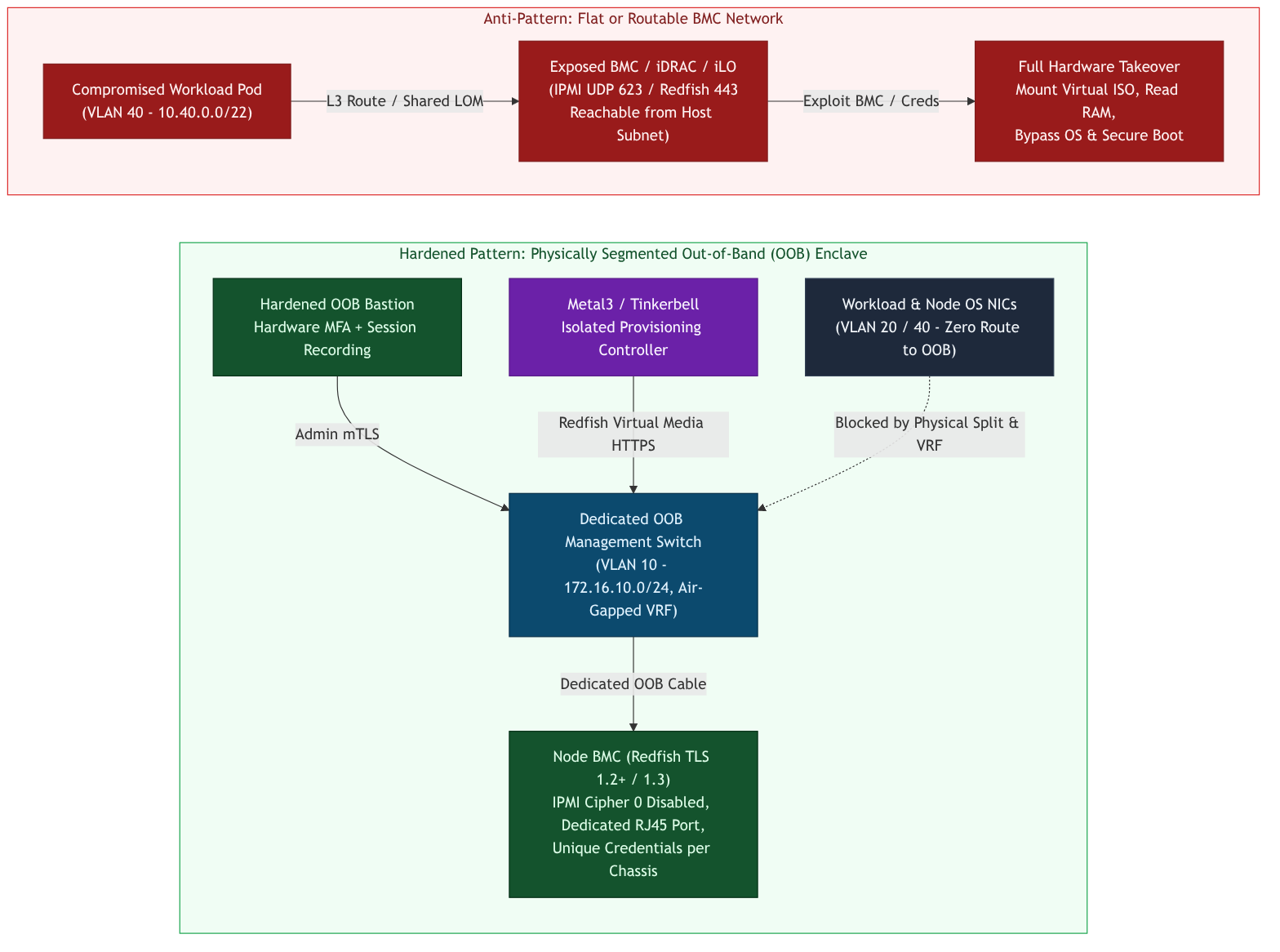
Every enterprise server ships with a second, hidden computer on the motherboard: Dell iDRAC, HPE iLO, Supermicro BMC, or ASRock Rack IPMI. The BMC has its own ARM processor, its own network stack, direct DMA access to host memory, virtual media mounting capabilities, and full power control. It runs even when the server is powered off.
Caution: If a workload pod or host OS can route packets to the BMC network, your entire Kubernetes security model is theater. A single container escape or missing egress NetworkPolicy allows an attacker to hit the BMC's Redfish API or IPMI port, mount a rogue recovery ISO, reboot the node, and dump raw
etcdorkubeletkeys.
Hardening the BMC Enclave
- Physical network separation: Wire the dedicated BMC RJ45 port to a completely separate out-of-band management switch fabric (
VLAN 10, e.g.,172.16.10.0/24) in an isolated VRF with zero L3 routing from workload, control-plane, or storage VLANs. Never enable "Shared LOM" or "Failover to Host NIC" in BIOS/BMC settings. - Disable legacy IPMI over LAN: IPMI v2.0 over UDP port 623 is notoriously insecure (including RAKP hash disclosure and Cipher Suite 0 authentication bypasses). Disable IPMI over LAN entirely and manage hardware exclusively over Redfish (HTTPS / TLS 1.2+) with custom CA certificates.
- Unique credentials and central auth: Rotate the factory BMC password immediately on intake, disable default accounts (
root/calvin), and bind BMC human access to an isolated OOB bastion requiring hardware FIDO2 MFA. - Continuous BMC firmware patching: BMC firmware vulnerabilities (such as Supermicro and iLO remote code execution flaws) are prime persistence targets because EDR and eBPF agents on the host OS cannot see inside the BMC processor.
Automated Provisioning with Metal3 and Tinkerbell
Manual PXE booting or hand-installing nodes via USB sticks leads to snowflakes and skipped Secure Boot enrollment. Use Cluster API (CAPI) paired with Metal3 or Tinkerbell running in an isolated management enclave to drive provisioning over Redfish Virtual Media (avoiding unauthenticated DHCP/TFTP PXE broadcasts on the workload network):
# Metal3 BareMetalHost: Write verified raw Talos image via Redfish Virtual Media (no PXE/TFTP)
apiVersion: metal3.io/v1alpha1
kind: BareMetalHost
metadata:
  name: worker-rack04-u12
  namespace: baremetal-system
spec:
  online: true
  # Boot Ironic Python Agent via Redfish Virtual Media over HTTPS with Secure Boot enforced
  bootMode: UEFISecureBoot
  bootMACAddress: "b4:96:91:aa:bb:cc"
  # Deterministic root disk selection by WWN so OS never overwrites Ceph OSD NVMe drives
  rootDeviceHints:
    wwn: "0x5002538e40821a90"
    rotational: false
  # Inject static bonded VLAN network config at pre-provisioning time (zero DHCP dependency)
  preprovisioningNetworkDataName: worker-rack04-u12-netdata
  bmc:
    address: redfish-virtualmedia+https://172.16.10.42/redfish/v1/Systems/System.Embedded.1
    credentialsName: worker-rack04-u12-bmc-creds
    disableCertificateVerification: false
  image:
    url: https://artifacts.infra.bard.sh/talos/v1.13.0/metal-amd64-secureboot.raw
    checksum: https://artifacts.infra.bard.sh/talos/v1.13.0/metal-amd64-secureboot.raw.sha256
    checksumType: sha256
    format: raw
  automatedCleaningMode: metadata
Notice bootMode: UEFISecureBoot, redfish-virtualmedia+https:// with disableCertificateVerification: false, and format: raw paired with checksum and rootDeviceHints so Ironic streams the verified Talos disk image onto the exact NVMe boot drive over TLS. (If you instead boot a stateless ISO directly into RAM, set format: live-iso and omit checksum, checksumType, and rootDeviceHints, which Metal3 ignores for live ISOs.)
Common Failure Modes & Operational Pitfalls
1. The "Bricked Fleet on BIOS Update" Trap
What happens: You bind LUKS2 disk decryption strictly to raw hashes of PCR 0, 1, 2, and 4 without a secondary key slot or signed PCR policy. Six months later, you roll out a motherboard BIOS update or microcode patch across a rack. PCR 0 changes, the TPM refuses to unseal the LUKS2 STATE partition, and all 40 servers drop into an initramfs recovery loop with no SSH and no remote console unlocks.
How to avoid it:
- Seal against PCR 7 (Secure Boot state/certificates) + PCR 11 (signed UKI policy), which survive minor firmware updates as long as the Secure Boot trust chain remains intact.
- Always configure Slot 1 in LUKS2 with a network-bound KMS key (such as Sidero Omni KMS or a Tang server inside your isolated management enclave) or clear/re-seal TPM PCR bindings cleanly as part of your automated firmware upgrade workflow.
2. "Shared LOM" Bridging the BMC onto the Host NIC
What happens: To save switch ports, a datacenter technician configures the server's BMC in "Shared LOM" (LAN on Motherboard) mode instead of using the dedicated iDRAC/iLO RJ45 port. The BMC now shares the physical 25GbE trunk port with the Kubernetes worker node. A misconfigured trunk native VLAN exposes the BMC web UI directly to pod traffic.
How to avoid it: Enforce Dedicated NIC selection in your declarative BIOS/Redfish configuration templates (NICSelection = Dedicated), and add a baseline CiliumClusterwideNetworkPolicy (CCNP) explicitly denying pod egress to all RFC1918 management and OOB CIDRs.
3. Relying on Microsoft's Third-Party UEFI CA Only
What happens: You enable UEFI Secure Boot in the BIOS using the factory default keys, which trust the Microsoft Corporation UEFI CA 2011. Any Linux live ISO, older vulnerable signed bootloader (BootHole), or signed kernel with init=/bin/bash enabled on the command line will gladly pass Secure Boot verification on that server.
How to avoid it: Use Unified Kernel Images (where the kernel command line and initramfs are baked into the signed PE binary) and enroll custom PK/KEK/db keys (or keep the UEFI revocation list dbx updated via fwupd/Redfish).
Summary Checklist
Before moving up to Layer 1, verify your foundation:
- Cloud: GKE Shielded Nodes (
enable_secure_boot,enable_integrity_monitoring, CMEK boot PD), AKS Trusted Launch (secure_boot_enabled,vtpm_enabled,host_encryption_enabledfor ephemeral OS disks), or EKS hardened UEFI/Nitro-TPM AMIs with CMEK EBS and IMDSv2 hop-limit 1. - Bare Metal Boot: UEFI Secure Boot enforced with signed Unified Kernel Images (UKIs) so
vmlinuz,initramfs, andcmdlinecannot be modified independently. - Bare Metal Disk:
STATEandEPHEMERALpartitions encrypted with LUKS2 bound to TPM 2.0 (PCR 7 + signed PCR 11) plus a Slot 1 network KMS fallback. - Attestation: Nodes prove hardware identity via SPIRE (
tpm_devid) and undergo continuous measured-boot and IMA verification via Keylime where supported. - OOB Enclave: BMC/iDRAC/iLO ports wired to a physically separate, non-routable VLAN; IPMI over LAN disabled; Redfish TLS verified; provisioning automated via Metal3 or Tinkerbell.
Day-1 Verification & Operational Runbook
Run these checks right after provisioning a new node pool or bare-metal rack to confirm Layer 0 controls are actually active:
# GKE: verify Shielded Nodes Secure Boot and vTPM integrity monitoring on a node pool
gcloud container node-pools describe hardened-workers \
  --cluster prod-gke --region us-central1 \
  --format="value(config.shieldedInstanceConfig.enableSecureBoot,config.shieldedInstanceConfig.enableIntegrityMonitoring)"

# AKS: verify Trusted Launch and host encryption on a node pool
az aks nodepool show --resource-group prod-rg --cluster-name prod-aks --name hardened \
  --query "{secureBoot:securityProfile.enableSecureBoot,vtpm:securityProfile.enableVtpm,hostEnc:enableEncryptionAtHost}"

# Talos bare metal: confirm Secure Boot and UKI boot state
talosctl -n 10.30.0.11 get securitystate
talosctl -n 10.30.0.11 get securitystate -o yaml
- Canary every BIOS and firmware rollout: Patch a single canary server and cold-reboot it before pushing a Dell, HPE, or Supermicro BIOS capsule across a rack to confirm PCR 7 + signed PCR 11 sealing unseals
STATEandEPHEMERALcleanly. - Verify physical OOB isolation from a host: Confirm from a worker node that there is no L3 route and zero TCP/UDP reachability to the OOB subnet (
172.16.10.0/24) and audit RedfishNICSelection = Dedicatedat hardware intake. - Drill the LUKS2 Slot 1 recovery path quarterly: Test unsealing
STATEvia the out-of-band network KMS fallback on a spare chassis after clearing the TPM so motherboard RMAs do not become unplanned data-loss events.