Created on 2026-11-27
Kubernetes Hardening L1: Infrastructure Network, API Perimeter, and Zero-Trust Access
TL;DR: Before a single packet reaches a pod or CNI plugin, your infrastructure network defines what can talk to your control plane, your nodes, and your storage fabric. On managed Kubernetes (EKS, GKE, AKS), hardening Layer 1 means turning off public kube-apiserver endpoints, routing control-plane traffic over private backbones (PrivateLink, DNS-based endpoints, VNet Integration), and stripping public IPs from worker nodes. On bare metal, it requires strict VLAN and VRF separation across five distinct traffic zones, Top-of-Rack (ToR) switch ACLs, authenticated BGP peering (TCP-MD5 in Cilium, or TCP-AO via FRR/BIRD), admission guardrails on LoadBalancer IP pools, and replacing legacy corporate VPNs with identity-aware proxies.
The Premise: The Perimeter Starts Outside the Cluster
Kubernetes networking discussions usually jump straight to NetworkPolicy and Service Meshes (Layers 7 and 8). That skips the underlay entirely. If your kube-apiserver port (6443) is exposed to 0.0.0.0/0, every CVE in the API server or webhook chain becomes an internet-facing crisis. If your bare-metal worker nodes share a flat Layer 2 subnet with your Ceph storage backend, etcd peers (2379-2380), and Top-of-Rack BGP routers, a single compromised node or rogue ARP announcement can intercept storage replication or hijack service VIPs.
Layer 1 hardening enforces three invariants:
- The
kube-apiserveris never directly reachable from the public internet. - Underlay networks are segmented by trust domain (Control Plane, Workload, Storage, Management, OOB).
- Human and CI/CD access to the API server is brokered per request by an identity-aware proxy - never granted wholesale by joining a flat corporate VPN.
Managed (EKS / GKE / AKS) vs. Self-Hosted Bare Metal
Cloud providers give you software-defined VPCs, security groups, and managed NAT gateways, but several providers still default to exposing a public API server endpoint unless you explicitly lock it down at cluster creation time.
| Security Control | AWS EKS | Google GKE | Azure AKS | Self-Hosted Bare Metal |
|---|---|---|---|---|
| API Server Exposure | endpoint_private_access = true, endpoint_public_access = false (or strict CIDR allowlist) |
DNS-based endpoint (allow_external_traffic = false, ip_endpoints_config.enabled = false) or private IP endpoint + Authorized Networks |
Private Cluster or API Server VNet Integration + --authorized-ip-ranges |
Internal HA VIP (Talos native VIP / kube-vip / HAProxy + keepalived) on an isolated Management VLAN |
| Cross-VPC / Hybrid API Access | AWS PrivateLink for EKS API + VPC Endpoints | Private Service Connect (PSC) / Cloud Interconnect | Azure Private Link / VNet Peering | Zero-Trust Proxy (Teleport, Pomerium, Tailscale, Boundary) |
| Node Underlay Isolation | Private subnets + Security Groups (separate CP and Worker SGs) | Private Nodes (enable_private_nodes = true) + VPC Firewall Rules |
Private subnet NSGs + Application Security Groups | VLAN + VRF separation enforced on Top-of-Rack (ToR) switches |
Service LoadBalancer Routing |
AWS Load Balancer Controller (ALB/NLB) with SG rules | GKE Gateway / Cloud Load Balancing + Cloud Armor | Azure Standard LB / Application Gateway for Containers | Cilium (CNCF Graduated) BGP / LB-IPAM (TCP-MD5) or MetalLB (CNCF Sandbox) with FRR (TCP-MD5 / TCP-AO) |
| Storage Traffic Separation | Dedicated ENIs / EFS & S3 VPC Endpoints | Private Google Access / Filestore PSC | Storage Service Endpoints / Private Endpoints | Dedicated Storage VLAN (e.g., VLAN 50) on separate host NICs / bonds |
Locking Down the Managed Control Plane Endpoint
The single highest-leverage Layer 1 change on EKS, GKE, or AKS is closing public 6443 access and forcing all API traffic through private network paths.
# AWS EKS: Disable public API endpoint and use API-only Access Entries.
# Note: PrivateLink VPC Endpoints for AWS APIs (ecr, sts, s3, logs) are provisioned separately (see Pitfall #2).
resource "aws_eks_cluster" "hardened" {
  name     = "prod-cluster"
  role_arn = aws_iam_role.eks_control_plane.arn
  version  = "1.36"

  vpc_config {
    subnet_ids              = var.private_cp_subnet_ids
    endpoint_private_access = true
    endpoint_public_access  = false
    security_group_ids      = [aws_security_group.eks_control_plane.id]
  }

  access_config {
    authentication_mode = "API"
    # WARNING: Setting this to false without an explicit aws_eks_access_entry locks out all admins.
    bootstrap_cluster_creator_admin_permissions = false
  }
}

# Grant a dedicated platform break-glass or GitOps admin role cluster access
resource "aws_eks_access_entry" "platform_admin" {
  cluster_name  = aws_eks_cluster.hardened.name
  principal_arn = var.platform_admin_role_arn
  type          = "STANDARD"
}

resource "aws_eks_access_policy_association" "platform_admin" {
  cluster_name  = aws_eks_cluster.hardened.name
  principal_arn = aws_eks_access_entry.platform_admin.principal_arn
  policy_arn    = "arn:aws:eks::aws:cluster-access-policy/AmazonEKSClusterAdminPolicy"

  access_scope {
    type = "cluster"
  }
}

# Google GKE: Private nodes + internal-only DNS-based control plane endpoint (IP endpoints disabled)
resource "google_container_cluster" "hardened" {
  name     = "prod-gke"
  location = var.region

  private_cluster_config {
    enable_private_nodes   = true
    master_ipv4_cidr_block = "172.16.0.0/28"
  }

  control_plane_endpoints_config {
    dns_endpoint_config {
      # Restricts DNS endpoint traffic to VPC, PSC, and Cloud Interconnect; auth is enforced via GCP IAM
      allow_external_traffic = false
    }
    ip_endpoints_config {
      # Disable IP-based control plane endpoints completely so all clients use the IAM-gated DNS endpoint
      enabled = false
    }
  }
}
On GKE, pay close attention to how IP endpoints and DNS endpoints authenticate differently:
- With
ip_endpoints_config { enabled = false }, both public and private IP endpoints are turned off. Everykubectland CI client talks to the Private Service Connect-backed DNS endpoint, where access is controlled by Google Cloud IAM (container.clusters.connect) and VPC Service Controls rather than CIDR allowlists (allow_external_traffic = falseblocks public internet routing). - If legacy in-VPC controllers still need the private IP endpoint, set
ip_endpoints_config { enabled = true }(withenable_private_endpoint = true) and attachmaster_authorized_networks_configscoped strictly to your zero-trust proxy subnet (e.g.,10.30.0.0/24).
On AKS, API Server VNet Integration projects the API server directly into a delegated subnet in your VNet without requiring Private DNS Zone gymnastics.
Bare Metal Deep Dive: 5-Zone VLAN and VRF Architecture
On bare metal, putting every server interface into a single /16 VLAN is a gift to attackers. If etcd peer ports (2380), kube-apiserver (6443), Ceph OSD replication (6800-7300), and tenant pod traffic all traverse the same broadcast domain, you have no underlay blast-radius containment.
A production bare-metal Kubernetes rack should split traffic into five distinct VLANs and VRFs at the Top-of-Rack (ToR) leaf switches, mapped onto bonded 25GbE/100GbE interfaces (e.g., 802.3ad LACP with 802.1Q VLAN tagging) plus a physically separate 1GbE RJ45 port for the BMC.
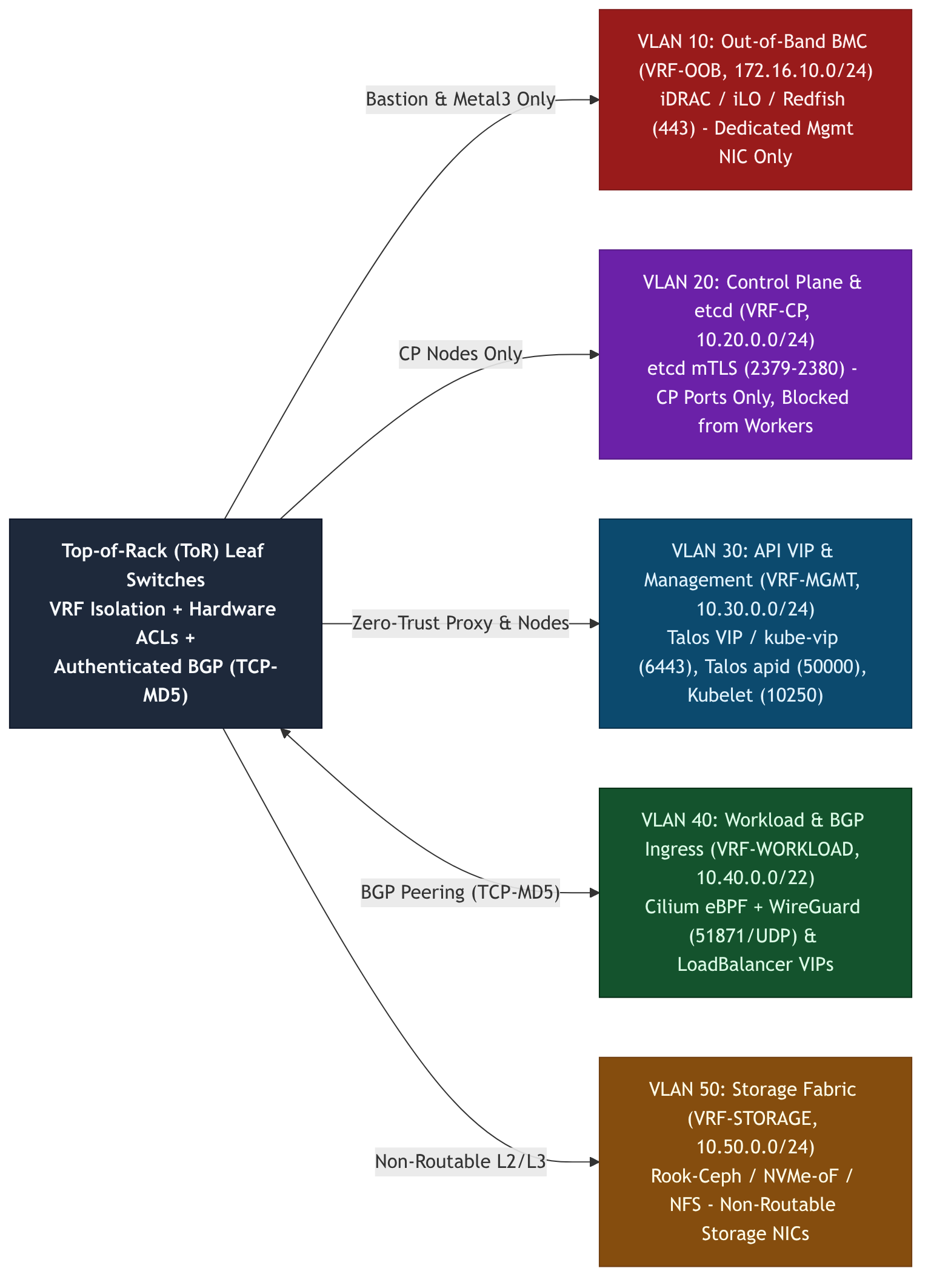
The Five Bare-Metal Network Zones
- VLAN 10 - Out-of-Band BMC (
VRF-OOB,172.16.10.0/24): Physically wired to the dedicated BMC port (covered in Layer 0). Zero L3 routes to any host or pod subnet. Only reachable from the OOB bastion and the Metal3 (CNCF Incubating) / Tinkerbell (CNCF Sandbox) provisioning controller. - VLAN 20 - Control Plane &
etcdInterconnect (VRF-CP,10.20.0.0/24): Provisioned only on control-plane switch ports.etcdbinds its peer (2380) and client (2379) listeners exclusively to the node'sVLAN 20IP. Worker nodes do not even haveVLAN 20trunked to their switch ports, making it physically impossible for a compromised worker node or pod to send a TCP SYN packet toetcd. - VLAN 30 - Cluster Management & API VIP (
VRF-MGMT,10.30.0.0/24): Hosts the internalkube-apiserverVirtual IP (10.30.0.10:6443via Talos Linux's built-in Layer 2 VIP, orkube-vip/ HAProxy + keepalived onkubeadmand Flatcar), node management APIs (such as Talosapidon50000), andkubelet(10250). ToR ACLs permit worker nodes onVLAN 30to reach10.30.0.10:6443, and permitkube-apiserverIPs to reach worker10250, while dropping worker-to-worker traffic on10250and50000. - VLAN 40 - Workload Underlay & BGP Ingress (
VRF-WORKLOAD,10.40.0.0/22): Carries node-to-node Cilium WireGuard (51871/UDP) encrypted pod traffic and establishes BGP peering sessions with the ToR switches to advertiseLoadBalancerservice VIPs. - VLAN 50 - Storage Fabric (
VRF-STORAGE,10.50.0.0/24): Non-routable Layer 2/Layer 3 storage network for Rook-Ceph (CNCF Graduated), NVMe-oF, or NFS storage appliances. Isolating storage on its own VLAN prevents tenant pods from directly probing Ceph Monitors/OSDs and keeps storage replication bursts from starving control-plane heartbeats.
Here is how you declare segmented VLAN sub-interfaces, explicit static routing, and etcd subnet binding in a Talos Linux control-plane configuration (using deviceSelectors instead of the deprecated bond.interfaces list):
# talos-cp-network-segmentation.yaml
machine:
  network:
    interfaces:
      - interface: bond0
        dhcp: false
        bond:
          mode: 802.3ad
          lacpRate: fast
          xmitHashPolicy: layer3+4
          # Select dual-port NICs deterministically by PCI bus path and driver
          deviceSelectors:
            - busPath: "0000:01:00.*"
              driver: i40e
        vlans:
          # VLAN 20: Dedicated Control Plane & etcd interconnect (CP nodes only)
          - vlanId: 20
            dhcp: false
            addresses:
              - 10.20.0.11/24
          # VLAN 30: Cluster Management & Talos built-in Layer 2 API Server VIP
          - vlanId: 30
            dhcp: false
            addresses:
              - 10.30.0.11/24
            vip:
              ip: 10.30.0.10
            routes:
              - network: 10.30.0.0/24
                gateway: 10.30.0.1
                table: 130
          # VLAN 40: Workload Underlay, Default Gateway & BGP Peering
          - vlanId: 40
            dhcp: false
            addresses:
              - 10.40.0.11/22
            routes:
              - network: 0.0.0.0/0
                gateway: 10.40.0.1
          # VLAN 50: Dedicated Storage Network (non-routable L2 fabric)
          - vlanId: 50
            dhcp: false
            addresses:
              - 10.50.0.11/24
cluster:
  etcd:
    # Bind etcd strictly to VLAN 20 so it is unreachable from VLAN 30/40/50
    advertisedSubnets:
      - 10.20.0.0/24
    listenSubnets:
      - 10.20.0.0/24
The vip: block configures Talos Linux's native built-in Layer 2 Virtual IP (managed directly by machined via leader election over etcd), which requires no external kube-vip static pod. On kubeadm or Flatcar clusters, run kube-vip or HAProxy with keepalived on VLAN 30 for the same floating endpoint.
Hardening Bare-Metal BGP and LoadBalancer IP Pools
On managed clouds, creating a Service of type LoadBalancer calls a cloud API to provision an ALB or NLB. On bare metal, you advertise service VIPs to your Top-of-Rack switches using BGP via Cilium BGP Control Plane, MetalLB, or kube-vip.
Two critical vulnerabilities show up in almost every default bare-metal BGP setup:
- Unauthenticated BGP sessions: If your ToR switch accepts unauthenticated BGP peers or uses a single shared password across all ports, a compromised node can inject bogus
/32routes and blackhole or intercept traffic for the entire cluster. - Unrestricted
LoadBalancerIP pools: By default, any namespace that can create aServicecan requesttype: LoadBalanceror setspec.loadBalancerIP/spec.externalIPs, allowing an internal development team to accidentally expose an unauthenticated service on a public ingress VIP or steal the production ingress gateway's IP.
1. Enforcing Authenticated BGP with Cilium
Cilium's built-in BGP control plane runs inside cilium-agent on every peering node and authenticates BGP sessions using TCP-MD5 (RFC 2385). Cilium does not implement TCP-AO (RFC 5925); if your network security standard mandates TCP-AO, terminate BGP in an external routing daemon such as FRR or BIRD on the host (or MetalLB's FRR mode where supported by your kernel and FRR version).
By default, Cilium reads authSecretRef secrets from kube-system. To isolate BGP passwords into a dedicated cilium-secrets namespace readable only by the cilium (cilium-agent) ServiceAccount via a namespace-scoped Role, set bgpControlPlane.secretNamespace.name explicitly in Cilium's Helm values, and pair it with strict ToR prefix-lists allowing only your designated LoadBalancer CIDR (never 0.0.0.0/0 or internal node subnets):
# Cilium Helm values excerpt: enable BGP Control Plane and scope auth secrets to cilium-secrets
bgpControlPlane:
  enabled: true
  secretNamespace:
    create: true
    name: cilium-secrets
---
apiVersion: cilium.io/v2
kind: CiliumBGPClusterConfig
metadata:
  name: dc-rack04-bgp-fabric
spec:
  nodeSelector:
    matchLabels:
      topology.kubernetes.io/rack: rack04
  bgpInstances:
    - name: "asn-65040-rack04"
      localASN: 65040
      peers:
        - name: "tor-leaf-a"
          peerASN: 65001
          peerAddress: "10.40.0.1"
          peerConfigRef:
            name: "tor-leaf-auth-peer"
        - name: "tor-leaf-b"
          peerASN: 65002
          peerAddress: "10.40.0.2"
          peerConfigRef:
            name: "tor-leaf-auth-peer"
---
apiVersion: cilium.io/v2
kind: CiliumBGPPeerConfig
metadata:
  name: tor-leaf-auth-peer
spec:
  # Reference TCP-MD5 (RFC 2385) password Secret in cilium-secrets (read by cilium-agent)
  authSecretRef: bgp-tor-peer-password
  timers:
    connectRetryTimeSeconds: 5
    holdTimeSeconds: 9
    keepAliveTimeSeconds: 3
  ebgpMultihop: 1
  # Keep forwarding live connections across Cilium DaemonSet upgrades
  gracefulRestart:
    enabled: true
    restartTimeSeconds: 120
  families:
    - afi: ipv4
      safi: unicast
      advertisements:
        matchLabels:
          advertise: bgp-public-vip
---
apiVersion: cilium.io/v2
kind: CiliumBGPAdvertisement
metadata:
  name: bgp-public-vip-advertisements
  labels:
    advertise: bgp-public-vip
spec:
  advertisements:
    - advertisementType: "Service"
      service:
        addresses:
          - LoadBalancerIP
      selector:
        matchExpressions:
          - key: io.kubernetes.service.namespace
            operator: In
            values: ["gateway-system"]
---
apiVersion: cilium.io/v2
kind: CiliumLoadBalancerIPPool
metadata:
  name: public-ingress-pool
spec:
  blocks:
    - cidr: "198.51.100.64/28"
  # CRITICAL: Restrict this public IP pool strictly to the gateway-system namespace
  serviceSelector:
    matchExpressions:
      - key: io.kubernetes.service.namespace
        operator: In
        values:
          - gateway-system
2. Blocking Unauthorized LoadBalancer and externalIPs via ValidatingAdmissionPolicy
Even with serviceSelector on your CiliumLoadBalancerIPPool, you should enforce an in-process ValidatingAdmissionPolicy (GA since Kubernetes 1.30) to block spec.externalIPs (associated with the classic CVE-2020-8554 MITM vector) and prevent tenant namespaces from creating type: LoadBalancer services at all:
apiVersion: admissionregistration.k8s.io/v1
kind: ValidatingAdmissionPolicy
metadata:
  name: restrict-loadbalancer-and-external-ips
spec:
  failurePolicy: Fail
  matchConstraints:
    resourceRules:
      - apiGroups: [""]
        apiVersions: ["v1"]
        operations: ["CREATE", "UPDATE"]
        resources: ["services"]
  validations:
    - expression: "!has(object.spec.externalIPs) || size(object.spec.externalIPs) == 0"
      message: "Setting spec.externalIPs is forbidden due to MITM spoofing risk (CVE-2020-8554)."
    - expression: >
        object.spec.type != 'LoadBalancer' ||
        request.namespace == 'gateway-system'
      message: "Only the gateway-system namespace may create Services of type LoadBalancer."
---
apiVersion: admissionregistration.k8s.io/v1
kind: ValidatingAdmissionPolicyBinding
metadata:
  name: restrict-loadbalancer-and-external-ips-binding
spec:
  policyName: restrict-loadbalancer-and-external-ips
  validationActions: [Deny]
Killing "VPN Equals Trust": Identity-Aware Proxies for kube-apiserver
Once your kube-apiserver is private (10.30.0.10:6443 on bare metal or a Private Endpoint on EKS/GKE/AKS), how do platform engineers and CI/CD runners reach it?
The legacy answer was a corporate VPN or an SSH bastion host: connect to OpenVPN or WireGuard, get an IP on 10.8.0.0/24, and route directly to the private cluster subnet. This violates Zero Trust. When an engineer's laptop has a flat Layer 3 route to the cluster management network, any malware, rogue browser extension, or compromised local tool on that laptop can scan kube-apiserver:6443, hit kubelet:10250 across every node, or reach internal databases.
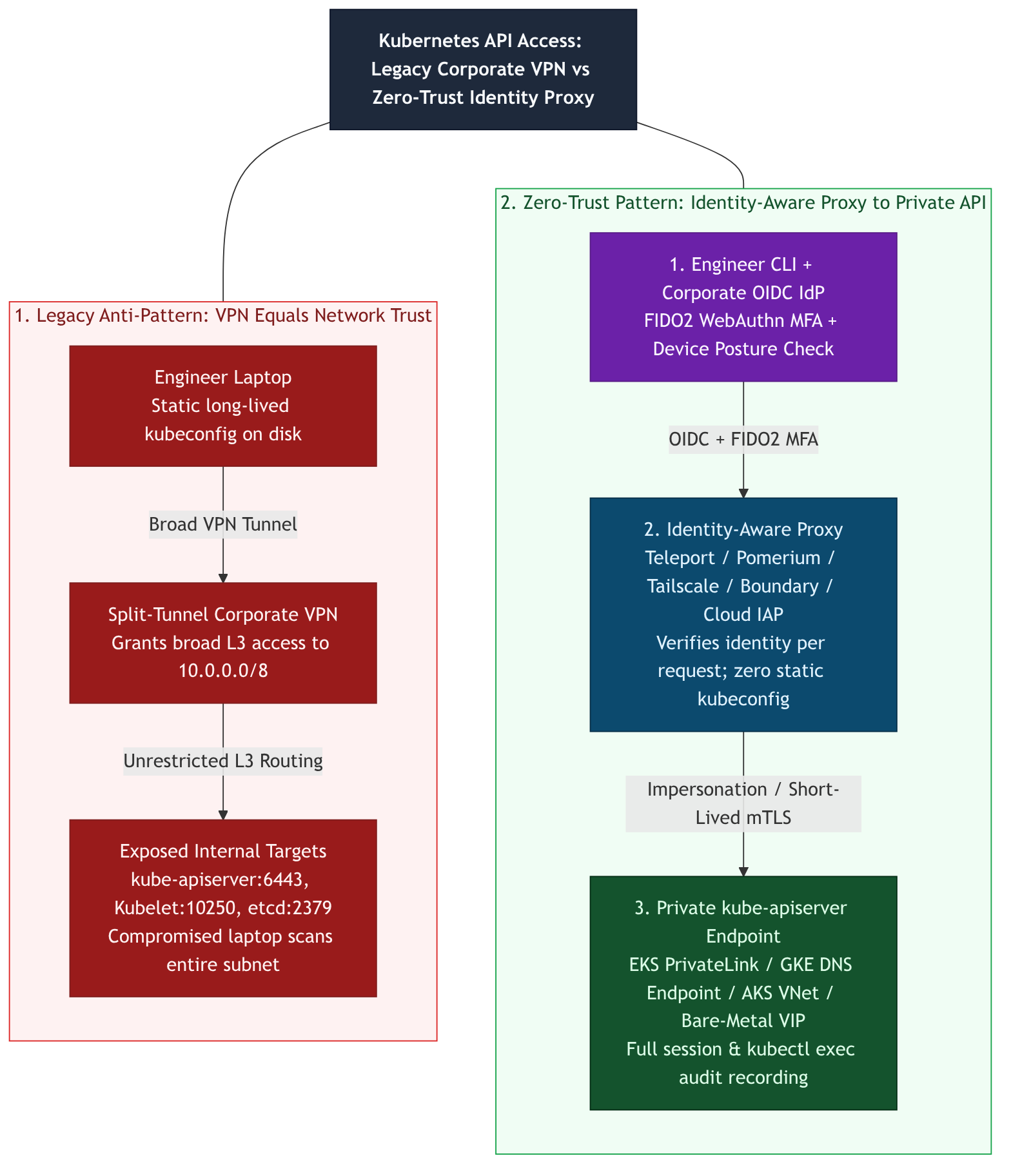
The Identity-Aware Proxy Pattern
Replace network-level VPN tunnels with an Identity-Aware Proxy (IAP) deployed inside the cluster or management enclave - such as Teleport, Pomerium, HashiCorp Boundary, Tailscale Kubernetes Operator (in API Server Proxy mode), or Google Cloud IAP.
In this architecture:
- Zero inbound ports required: The proxy agent runs inside the cluster or Management VLAN and dials out to the zero-trust coordination plane, or terminates TLS at a hardened edge proxy that only speaks HTTPS after OIDC authentication.
- Per-request identity & device posture: Before forwarding a single
kubectlrequest tohttps://10.30.0.10:6443, the proxy verifies the user's OIDC identity, enforces hardware FIDO2/WebAuthn MFA, and checks device posture (OS version, disk encryption, EDR status). - No static human
kubeconfigsecrets: Engineers never store long-lived cluster certificates on their laptops. When deployed in-cluster (teleport-kube-agent), the agent authenticates tokube-apiserverusing its automatically rotated projected ServiceAccount token and Kubernetes impersonation headers (Impersonate-User,Impersonate-Group). If you instead run the proxy externally onVLAN 30, configure short-lived, auto-rotated mTLS client certificates rather than static kubeconfig files. - Full
kubectl execsession recording: Because the proxy terminates and inspects the Kubernetes API protocol, it records interactivekubectl execandkubectl attachterminal sessions in full - something rawkube-apiserveraudit logs cannot do (sincekube-apiserveronly logs the initialexecrequest, not the keystrokes inside the WebSocket/SPDY stream).
Here is an example of configuring an in-cluster Teleport Kubernetes Service agent (using its projected ServiceAccount token with zero static kubeconfig_file) paired with a Teleport role enforcing OIDC identity mapping ({{external.email}}), hardware FIDO2 MFA, 8-hour TTLs, and mandatory session recording:
# teleport.yaml (in-cluster teleport-kube-agent; uses rotated projected ServiceAccount token)
version: v3
teleport:
  nodename: k8s-iap-prod-01
  proxy_server: teleport.bard.sh:443
auth_service:
  enabled: "no"
ssh_service:
  enabled: "no"
kubernetes_service:
  enabled: "yes"
  # Omitting kubeconfig_file in-cluster uses the Pod's short-lived projected ServiceAccount token
  kube_cluster_name: prod-eu-central-1
  labels:
    env: production
    location: dc-eu-central-1
---
# Teleport Role requiring per-session hardware MFA and OIDC claim mapping
kind: role
version: v7
metadata:
  name: prod-k8s-sre
spec:
  options:
    max_session_ttl: 8h
    require_session_mfa: hardware_key_touch
    record_session:
      default: strict
  allow:
    kubernetes_labels:
      env: production
    kubernetes_groups: ["sre-oncall"]
    # Map OIDC SSO user identity via {{external.email}} (or {{external.username}}), never {{internal.logins}}
    kubernetes_users: ["{{external.email}}"]
Common Failure Modes & Operational Pitfalls
1. The EKS endpoint_public_access = true Default Trap
What happens: An engineer provisions an EKS cluster with endpoint_private_access = true assuming that makes the cluster private. However, in the AWS EKS API and Terraform provider, endpoint_public_access defaults to true with public_access_cidrs = ["0.0.0.0/0"] unless you explicitly set endpoint_public_access = false. The API server remains exposed to the entire internet.
How to avoid it: Always explicitly set endpoint_public_access = false in your Terraform modules, and enforce it with an AWS Config rule (eks-endpoint-no-public-access) or Kyverno/OPA pre-deployment check on your Terraform plans.
2. Private API Server Without VPC Endpoints (Node Bootstrap Failure)
What happens: You disable public API access and place worker nodes in isolated private subnets with no NAT Gateway. The nodes fail to join the cluster because kubelet and containerd cannot reach ecr.api, ecr.dkr, s3 (for image layers), sts (for IAM), or ec2.
How to avoid it: Before disabling outbound internet access on private node subnets, provision VPC Interface Endpoints (PrivateLink) for ecr.api, ecr.dkr, sts, logs, and ssm, plus a Gateway Endpoint for s3 (or run a local pull-through cache like Harbor (CNCF Graduated) on bare metal).
3. Hairpin / Asymmetric Routing and Strict rp_filter=1 on Multi-Homed Cilium Nodes
What happens: You segment VLAN 30 (Management) and VLAN 40 (Workload) on bare-metal nodes without source-based policy routing, or you enable strict reverse-path filtering (net.ipv4.conf.all.rp_filter=1). Return packets from bond0.30 (10.30.0.11) leave out of the default gateway on bond0.40 (10.40.0.1), or strict rp_filter=1 silently blackholes Cilium WireGuard (cilium_wg0) and ECMP BGP traffic whose ingress interface does not match the primary FIB route.
How to avoid it: Assign a dedicated routing table and source-based routing rule (ip rule) for each management and storage VLAN interface (keeping the default route on the primary underlay interface), and set loose reverse-path filtering (net.ipv4.conf.all.rp_filter=2, net.ipv4.conf.default.rp_filter=2) - or rp_filter=0 paired with net.ipv4.conf.all.src_valid_mark=1 where required by Cilium WireGuard and multi-homed BGP ECMP.
Summary Checklist
Before moving up to Layer 2 (Node & OS Hardening), verify your Layer 1 perimeter:
- Private API Server: Public endpoint disabled (
endpoint_public_access = false+ explicit Access Entries on EKS;ip_endpoints_config { enabled = false }+allow_external_traffic = falseon GKE DNS endpoint; Private Cluster / VNet Integration on AKS; internal VIP on bare metal). - Underlay Segmentation: Bare-metal VLANs/VRFs separate BMC (
VLAN 10),etcd/Control Plane (VLAN 20), API/Management (VLAN 30), Workload (VLAN 40), and Storage (VLAN 50), with looserp_filter=2(or0+src_valid_mark=1) for Cilium WireGuard and ECMP. - Authenticated BGP: Bare-metal BGP peers use TCP-MD5 (Cilium
cilium-agentreading fromcilium-secrets) - or TCP-AO via FRR/BIRD - plus strict prefix-list filtering on ToR switches. - LoadBalancer Guardrails:
ValidatingAdmissionPolicy(restrict-loadbalancer-and-external-ips) blocksspec.externalIPsand restrictstype: LoadBalancerstrictly togateway-system. - Zero-Trust API Access: Flat VPN access to the cluster subnet replaced with an identity-aware proxy enforcing OIDC SSO, hardware MFA, and
kubectl execsession recording.
Day-1 Verification & Operational Runbook
Verify perimeter lockdown, BGP authentication, and LoadBalancer admission rules immediately after cluster bootstrap:
# AWS EKS: verify public API exposure is disabled
aws eks describe-cluster --name prod-cluster \
  --query "cluster.resourcesVpcConfig.{Public:endpointPublicAccess,Private:endpointPrivateAccess}"

# Bare metal (Cilium): verify established BGP sessions and advertised VIP prefixes
cilium bgp peers
cilium bgp routes advertised ipv4 unicast

# Verify ValidatingAdmissionPolicy is bound and active
kubectl get validatingadmissionpolicy restrict-loadbalancer-and-external-ips
kubectl get validatingadmissionpolicybinding restrict-loadbalancer-and-external-ips-binding
- Validate VPC endpoints before cutting off NAT or public access: Confirm
ecr.api,ecr.dkr,sts,logs,ssm, ands3endpoints are reachable from private worker subnets before removing NAT Gateways so node bootstrap and image pulls do not stall. - Test
restrict-loadbalancer-and-external-ipsin staging: Run a server-side dry-run applying aServicewithspec.externalIPs: ["198.51.100.1"]and atype: LoadBalancerService in an application namespace to verify immediate rejection bykube-apiserver. - Audit ToR BGP prefix lists during rack turn-up: Verify leaf switches accept only the designated
CiliumLoadBalancerIPPoolprefix (198.51.100.64/28) from rack worker peers and drop any advertisement overlappingVLAN 10/20/30/50.